How AI Ranks Home Service Companies in 2026

# How AI Ranks Home Service Companies in 2026
AI ranks home service companies by synthesizing verified data from dozens of third-party sources, not by reading your website. This process, formally called entity-based ranking, evaluates your business's credibility through review distribution, name-address-phone consistency, earned media, and operational signals. Understanding how AI evaluates service providers is the difference between showing up when a customer needs you and being invisible. The contractors winning in AI search right now are not necessarily the best at their trade. They are the best at managing their digital presence across every platform that AI reads.
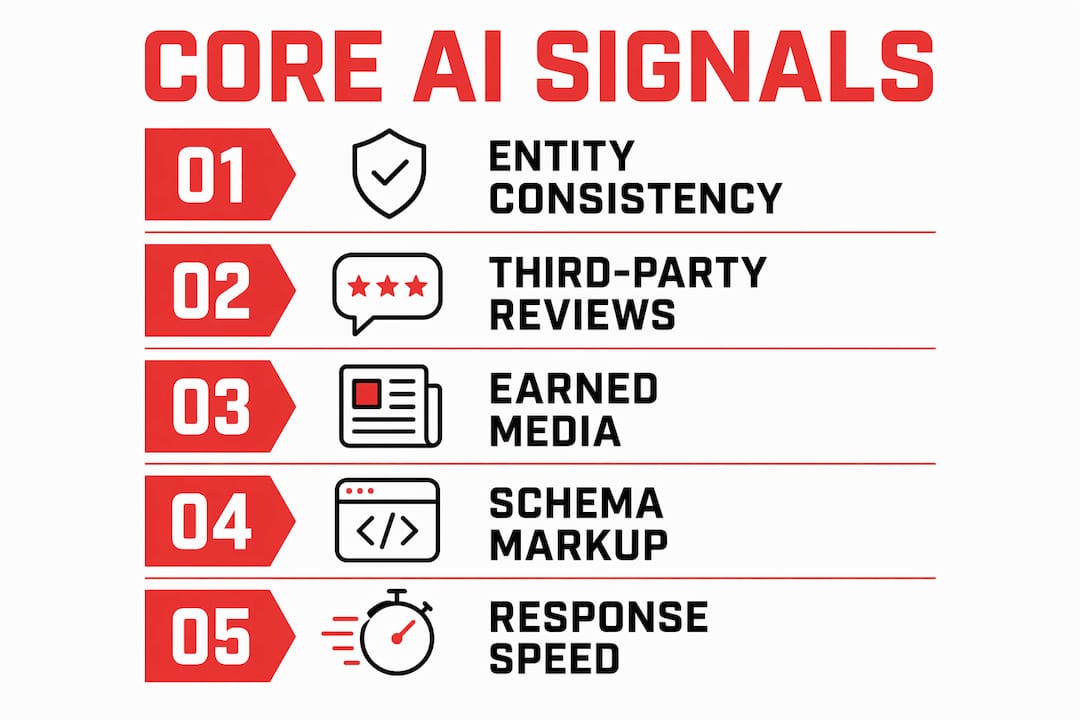
How AI ranks home service companies: the core signals
AI does not rank businesses the way Google's traditional algorithm does. Entity consistency is the foundation, meaning your business name, address, and phone number must match exactly across every directory, review site, and citation source. A single inconsistency, like "St." on one platform and "Street" on another, creates doubt in the AI's model of your business.
Third-party sources drive approximately 85% of all AI business citations. Your own website content accounts for the remaining 15%. That ratio alone should change how you allocate your time and budget.

AI systems also use a decision-shaping model before recommending any provider. AI engines establish criteria like cost, expertise, and availability first, then match businesses to those criteria. If your profiles do not clearly signal those attributes, you will not appear, even if you are the best contractor in your city.
What trust signals does AI evaluate for home service rankings?
AI pulls from a specific set of trust signals to decide which contractors to recommend. These signals are weighted differently than traditional SEO factors, and understanding them gives you a real edge.
- —NAP consistency: Your business name, address, and phone number must be identical across Google Business Profile, Yelp, BBB, Angi, and every directory where you appear. Any mismatch reduces AI confidence in your entity.
- —Distributed reviews: Reviews spread across multiple platforms carry far more weight than a large volume on a single site. Google, Yelp, BBB, and Houzz each contribute to your credibility score.
- —Earned media: Third-party earned media is weighted 10 to 30 times more heavily than your own website content. A mention in a local news outlet or a trade publication moves the needle more than any blog post you write.
- —Schema markup: Structured data tells AI exactly what your business does, where it operates, and what customers say about it. Without schema, AI has to guess, and it often guesses wrong.
- —Review recency: Fresh reviews signal that your business is active. A contractor with 200 reviews from three years ago ranks below one with 40 reviews from the past six months.
Pro Tip: Build citations on at least five distinct platforms before focusing on volume on any single one. AI rewards breadth of presence, not depth on one site.
Traditional SEO tactics like backlink counts and keyword density rank as secondary signals in AI evaluation. Schema markup and entity consistency carry far more weight. If you have been pouring budget into backlinks and ignoring your Google Business Profile, you are optimizing for the wrong system.
Why do independent contractors struggle to rank in AI recommendations?
Independent operators face a structural disadvantage in AI search. Independent local operators capture only about 22% of AI citations, suffering an 8x disadvantage compared to chains and aggregators. Large aggregators publish extensive press releases, investor disclosures, and media coverage that AI indexes constantly.
The scale gap is severe. Independent contractors have web footprints that are 10,000 to 100,000 times smaller than large aggregators. That means fewer citations, fewer indexed pages, and far less data for AI to use when deciding who to recommend.
There is also a hidden data problem. Operational data like repeat customer rates and average ticket sizes sits locked inside proprietary CRM software and never gets published where AI can read it. A contractor with a 90% repeat customer rate has no way to signal that quality to an AI system unless that data appears somewhere publicly accessible.
Here is what independent contractors can do right now to close the gap:
- —Claim and fully complete your profile on Google Business Profile, Yelp, BBB, Angi, and Houzz.
- —Submit your business to local chamber of commerce directories and regional trade association listings.
- —Ask satisfied customers to leave reviews on at least two different platforms, not just Google.
- —Publish case studies or project summaries on your website using schema markup so AI can index your work history.
- —Reach out to local news outlets and home improvement blogs for features or expert quotes.
Pro Tip: One local news mention about your business generates more AI visibility than 20 new backlinks. Pitch a story angle, not a press release.
How do reviews and response speed affect AI provider rankings?
Reviews are not just a reputation tool. They are a direct ranking input. AI assistants provide specific local business recommendations for 87% of home service queries, and review signals heavily shape which businesses appear. More reviews across more platforms generate greater trust and visibility in AI outputs.
Responsiveness is equally critical, and most contractors underestimate it. AI referral traffic converts at 4 to 23 times the rate of traditional search traffic. That conversion advantage disappears fast when calls go unanswered. The same data shows that 27% of calls remain unanswered, and AI systems track this pattern and downgrade providers who miss inquiries.
The ranking logic here is straightforward:
- 1.Review volume: More reviews across more platforms signal a credible, active business.
- 2.Review recency: Reviews from the past 90 days carry more weight than older ones.
- 3.Review diversity: Ratings on Google, Yelp, and BBB together outperform a high volume on one platform alone.
- 4.Call answer rate: AI systems factor in whether businesses respond to the leads they receive.
- 5.Conversion signals: High booking rates from AI-referred leads reinforce your ranking position over time.
Missing a call from an AI-referred customer does not just cost you that job. It signals to the AI that you are not a reliable provider, which reduces how often you appear in future recommendations.
What steps can home service companies take to improve AI rankings?
Improving your AI ranking is a systematic process. It requires consistent effort across several fronts, and the contractors who treat it as an ongoing operation rather than a one-time fix see the best results.
Build and maintain NAP consistency
Audit every directory where your business appears. Use the exact same business name, address, and phone number everywhere. Check Google Business Profile, Yelp, BBB, Angi, Facebook, Apple Maps, and any local chamber listings. Tools like Moz Local or BrightLocal can surface inconsistencies at scale. Fix every mismatch before building new citations.
Distribute your review gathering
Stop asking customers to review you only on Google. Spread requests across Google, Yelp, BBB, Angi, and Houzz. A contractor with 30 reviews on five platforms outranks one with 150 reviews on a single site in AI-generated recommendations. Build a simple follow-up process, whether by text or email, that directs customers to different platforms in rotation.
Earn third-party media mentions
Contact your local newspaper, neighborhood blog, or regional home improvement publication. Offer to comment as an expert on seasonal topics like seasonal home maintenance or common repair issues. A single published quote with your business name and city creates an AI-readable citation that no amount of website content can replicate.
Implement schema markup on your website
Schema markup is structured data code that tells AI exactly what your business is, where it operates, and what services it provides. Use LocalBusiness schema at minimum. Add Service schema for each trade you offer. If you use a conversion-focused website built for contractors, schema is often included, but verify it is implemented correctly using Google's Rich Results Test.
Improve lead response speed
Answer every call. If you cannot staff a phone line around the clock, use an AI receptionist tool to capture and qualify leads 24 hours a day. AI systems track responsiveness as a ranking signal. Every missed call is a data point working against your visibility.
Pro Tip: Set a target of responding to every new inquiry within five minutes. Businesses that hit this threshold see significantly higher booking rates from AI-referred leads.
The table below shows how different optimization efforts compare in their impact on AI ranking signals:
| Optimization effort | Primary AI signal affected | Relative impact |
|---|---|---|
| NAP consistency audit | Entity trust | High |
| Multi-platform review distribution | Third-party consensus | High |
| Local media mentions | Earned authority | Very high |
| Schema markup implementation | Structured data clarity | High |
| 24/7 call answering | Responsiveness signal | Medium to high |
Key takeaways
AI ranks home service companies by measuring entity consistency, distributed third-party reviews, earned media authority, and operational responsiveness, not by how well your website is written.
| Point | Details |
|---|---|
| Entity consistency is foundational | Identical NAP data across all platforms builds AI confidence in your business. |
| Third-party sources dominate citations | 85% of AI citations come from external sources, not your own website. |
| Independent contractors face an 8x gap | Chains and aggregators capture citations at a rate that leaves independents with only 22% of AI recommendations. |
| Responsiveness affects rankings directly | Unanswered calls signal unreliability to AI systems and reduce future visibility. |
| Earned media outweighs website content | A local news mention carries 10 to 30 times more AI ranking weight than a blog post. |
The visibility gap is wider than most contractors realize
Most contractors I talk to are still fighting the last war. They are focused on their website's keyword rankings while AI systems are pulling recommendations from Yelp, BBB, local news archives, and trade directories they have never touched. The shift from traditional search to AI-generated recommendations is not gradual. It is already here, and the contractors who understand it are capturing customers that everyone else is losing.
The hardest part to accept is that your actual quality of work barely registers in AI ranking calculations unless it shows up in public, third-party data. A contractor who does mediocre work but has 80 reviews across five platforms and a mention in the local paper will outrank an excellent contractor with 20 Google reviews and no external citations. That is not fair. It is just how the system works.
What I have seen work consistently is treating your digital presence like a second business. You maintain it, invest in it, and measure it. The contractors who get featured in AI recommendations are not the ones with the fanciest websites. They are the ones who show up everywhere, respond fast, and have customers talking about them in public places that AI can read.
Start with the basics: fix your NAP consistency, spread your review requests across platforms, and get one local media mention this quarter. Those three moves alone will put you ahead of most independent operators in your market. The Vaultio blog covers these tactics in depth if you want to go further.
— Damian
Vaultio's approach to AI visibility for contractors
Contractors who want to rank in AI-generated recommendations need more than a good website. They need a system that manages every signal AI reads, from review distribution to structured data to lead response speed.
Vaultio builds and manages that system for home service contractors. The local SEO and AI visibility service covers Google Maps rankings and AI-powered search recommendations across ChatGPT and other platforms. The AI automation tools handle lead response around the clock so you never miss an inquiry that could hurt your ranking. Vaultio's reputation management keeps your reviews fresh and distributed across every platform that matters. The result is a predictable flow of booked jobs, backed by a 30-day money-back guarantee.
FAQ
How does AI decide which home service companies to recommend?
AI recommends businesses based on entity consistency, distributed third-party reviews, earned media mentions, and schema markup. Approximately 85% of AI citations come from external sources rather than a company's own website.
Does traditional SEO still matter for AI rankings?
Traditional factors like backlink counts and keyword density are secondary signals. Entity consistency verified through schema markup and matching business data across platforms carries significantly more weight in AI ranking calculations.
Why do large chains rank higher than independent contractors in AI search?
Large chains and aggregators generate far more third-party citations through press coverage and directory presence. Independent operators capture only about 22% of AI citations, facing an 8x disadvantage compared to chains.
How does call responsiveness affect AI rankings?
AI systems track whether businesses respond to the leads they receive. With 27% of calls going unanswered, contractors who miss inquiries signal unreliability to AI platforms, which reduces how often they appear in future recommendations.
How many platforms should I collect reviews on for better AI visibility?
Reviews distributed across at least five platforms, including Google, Yelp, BBB, Angi, and Houzz, build stronger AI credibility than a high volume concentrated on a single site. Breadth of presence across platforms is the key factor.
Recommended
Ready to Implement This?
We'll build your complete lead generation system in 72 hours. No contracts. 30-day money-back guarantee.